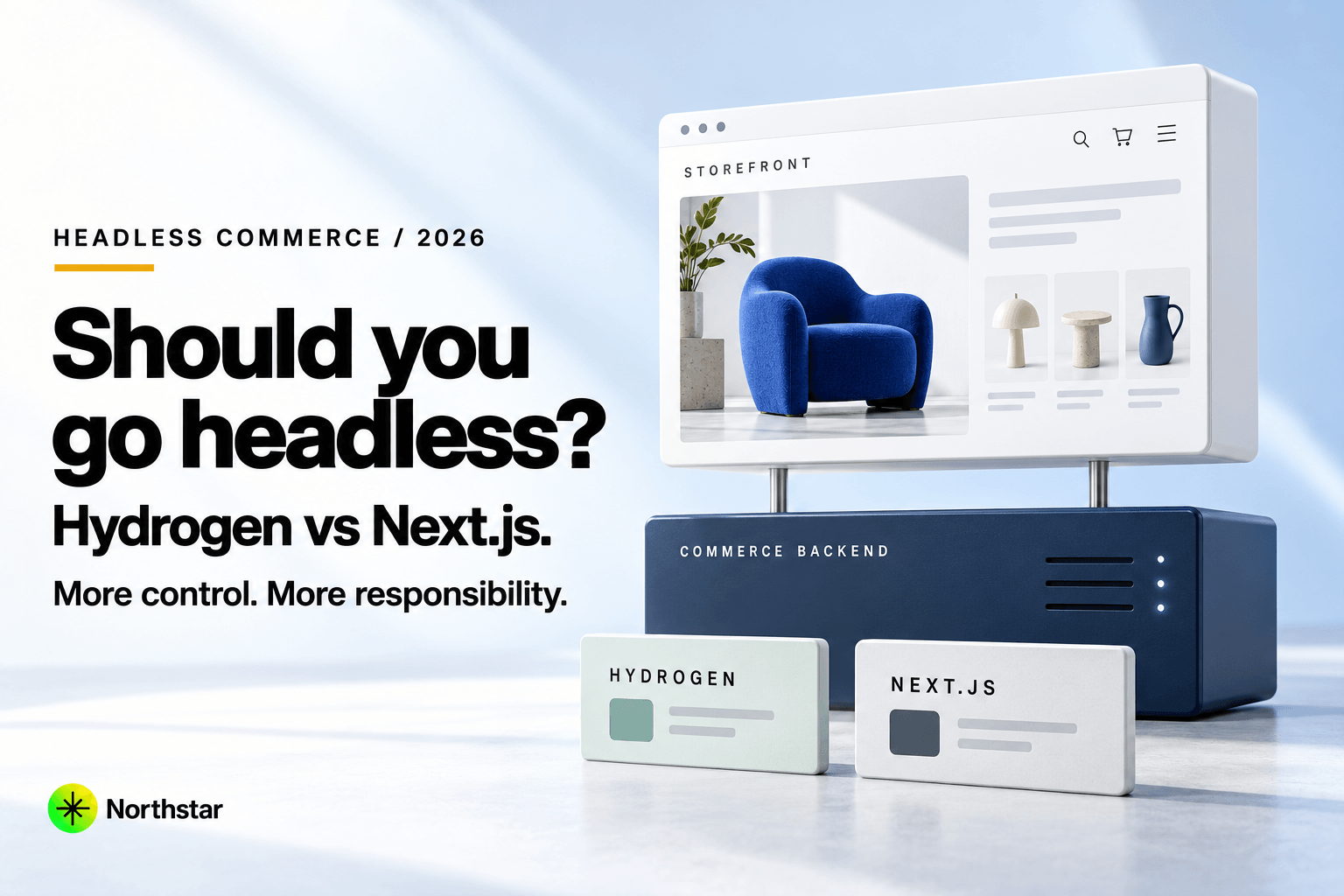
"Should we go headless?" has become one of the most frequently asked architectural questions by seven- and eight-figure eCommerce brands. Decoupling your frontend storefront from your eCommerce engine promises lightning-fast page transitions, bespoke shopping experiences, and complete freedom from theme constraints.
However, going headless also changes your operational reality: you replace a turnkey theme environment with custom software that requires continuous engineering, monitoring, and infrastructure. Before committing six figures to a rebuild, here is a practical breakdown of when headless makes sense, how Shopify Hydrogen compares to custom Next.js storefronts, and when you should stay on a standard monolithic theme.
What "Going Headless" Actually Changes
In a traditional monolithic setup (like standard Shopify Liquid or BigCommerce Stencil), the platform handles everything: the database, business logic, checkout, and frontend HTML templating. When a customer loads a product page, Shopify renders the Liquid templates on its servers and returns the rendered HTML.
In a headless architecture, your eCommerce platform serves strictly as a backend database and checkout engine via GraphQL APIs. The customer-facing website is an independent web application—usually built with React frameworks like Next.js or Remix (via Shopify Hydrogen)—hosted on edge platforms like Oxygen, Vercel, or Netlify.
The Real Advantages: Why Brands Decouple
Merchants who successfully make the transition do so for specific, tangible business drivers:
- Sub-second speed and Core Web Vitals: By running on modern edge networks with fine-grained static generation (SSG) and incremental revalidation (ISR), headless storefronts eliminate server rendering bottlenecks. Faster load times directly improve conversion rates on mobile traffic and paid ad landing pages.
- Content-commerce fusion: If your brand relies heavily on editorial storytelling, lookbooks, interactive product builders, or complex quizzes, traditional theme customizers quickly hit a wall. Headless allows you to pair Shopify with enterprise headless CMS platforms like Sanity, Strapi, or Contentful seamlessly.
- Omnichannel and multi-storefront scale: A single decoupled frontend application can pull products from multiple regional backends or display catalog data across websites, mobile apps, native kiosks, and customer portals.
- Developer velocity and modern tooling: Engineering teams can leverage modern component libraries, TypeScript, automated CI/CD pipelines, and robust testing frameworks without being locked into proprietary template syntax.
Shopify Hydrogen vs Next.js: Choosing Your Stack
If you decide that headless is the right architectural direction, the two dominant React-based ecosystems in 2026 are Shopify Hydrogen (powered by Remix) and Next.js.
Option 1: Shopify Hydrogen & Oxygen
Hydrogen is Shopify's official opinionated stack for headless commerce, built on Remix and hosted on Shopify's global Oxygen edge infrastructure.
- Native Shopify alignment: Hydrogen comes pre-wired with the Storefront API, Cart hooks, Customer Account API, and analytics primitives maintained directly by Shopify's core team.
- Included edge hosting: Oxygen hosting is included in Shopify Plus subscriptions, eliminating separate Vercel/AWS compute bills.
- Streaming SSR: Built-in support for optimistic UI updates and nested routing via Remix makes complex product customizers feel instant.
- Trade-off: The ecosystem of third-party templates and plugins is smaller than Next.js, and you are tied to the Remix paradigm.
Option 2: Next.js Storefront Framework
Next.js (paired with BigCommerce Catalyst, Shopify Storefront API, or Medusa) is the industry standard for general composable web development.
- Maximum architectural flexibility: Effortlessly integrate any third-party backend, ERP API, or specialized recommendation engine alongside your eCommerce catalog.
- Massive developer ecosystem: Widest availability of skilled React engineers, UI components, and third-party integrations in the software industry.
- Advanced caching: Granular control over edge caching, ISR, and React Server Components (RSC) to serve millions of cache-hit pages at near-zero latency.
- Trade-off: You manage your own hosting infrastructure (Vercel, AWS, Cloudflare), and integration glue code requires ongoing maintenance.
The Hidden Trade-Offs: Why Most Stores Shouldn't Go Headless
Headless is not an automatic upgrade. For many merchants, the trade-offs far outweigh the benefits:
- App store disconnect: Standard "one-click" Shopify apps (review widgets, bundle builders, loyalty apps) do not automatically work on headless frontends. Each feature requires custom API integration or headless-ready SDKs.
- Loss of the native Theme Editor: Non-technical marketing teams can no longer drag-and-drop theme sections unless you invest significant development budget into building visual editing via a headless CMS (like Sanity Studio or Builder.io).
- Engineering overhead: You need an ongoing relationship with experienced frontend engineers to maintain dependencies, update APIs, and manage deployments.
- Higher initial investment: While a custom Liquid theme build typically ranges from $15,000 to $50,000, production headless storefronts frequently start at $40,000 and can easily exceed $100,000 for enterprise scopes.
The Decision Checklist
Ask yourself these four questions before embarking on a headless journey:
- Are you hitting concrete performance ceilings? If your current Liquid or Stencil store is bloated primarily because of 35 redundant tracking apps, an app audit and code cleanup is 10x cheaper than going headless.
- Do you have dedicated development resources? If you rely on non-technical staff to build landing pages weekly without developer support, standard Shopify Online Store 2.0 is almost certainly the better fit.
- Do you require rich, bespoke digital experiences? If you are building 3D configurators, complex subscription logic, or multi-brand unified carts, headless gives you the control you need.
- Does your annual revenue justify the infrastructure? Unless your store is driving multi-million-dollar volume where a 5-10% lift in conversion covers the development investment, the ROI math rarely works out.
How Northstar Approaches Headless Builds
We believe headless commerce is an incredible architecture when applied to the right problems—and a costly distraction when applied to the wrong ones. We never push clients toward headless simply because it is technically fashionable.
Explore our dedicated headless commerce services to see how we build high-speed Next.js and Hydrogen stores, or check our custom Shopify development and BigCommerce development solutions for high-performance theme builds. If you are weighing the decision right now, reach out for an architectural consultation and we will give you an honest, numbers-first evaluation.